On this page +
Noble houses reference
Noble houses are the political engine of County of Fortune. Each mayor belongs to one, each house accumulates power through the settlements it runs, and that power determines who wins elections and whose privileges shape the county.
What noble houses do
A noble house is a political faction with a banner, a power share and relationships with other houses. Its mayors run settlements, its stewards represent regions and its influence determines how many votes it can persuade in elections and the Assembly.
Houses are not a separate minigame you can ignore. A house that becomes too powerful can force an Assembly, and a house with high influence can push through privileges that help or hurt your economy. The political layer sits directly on top of the production layer.
Power and influence
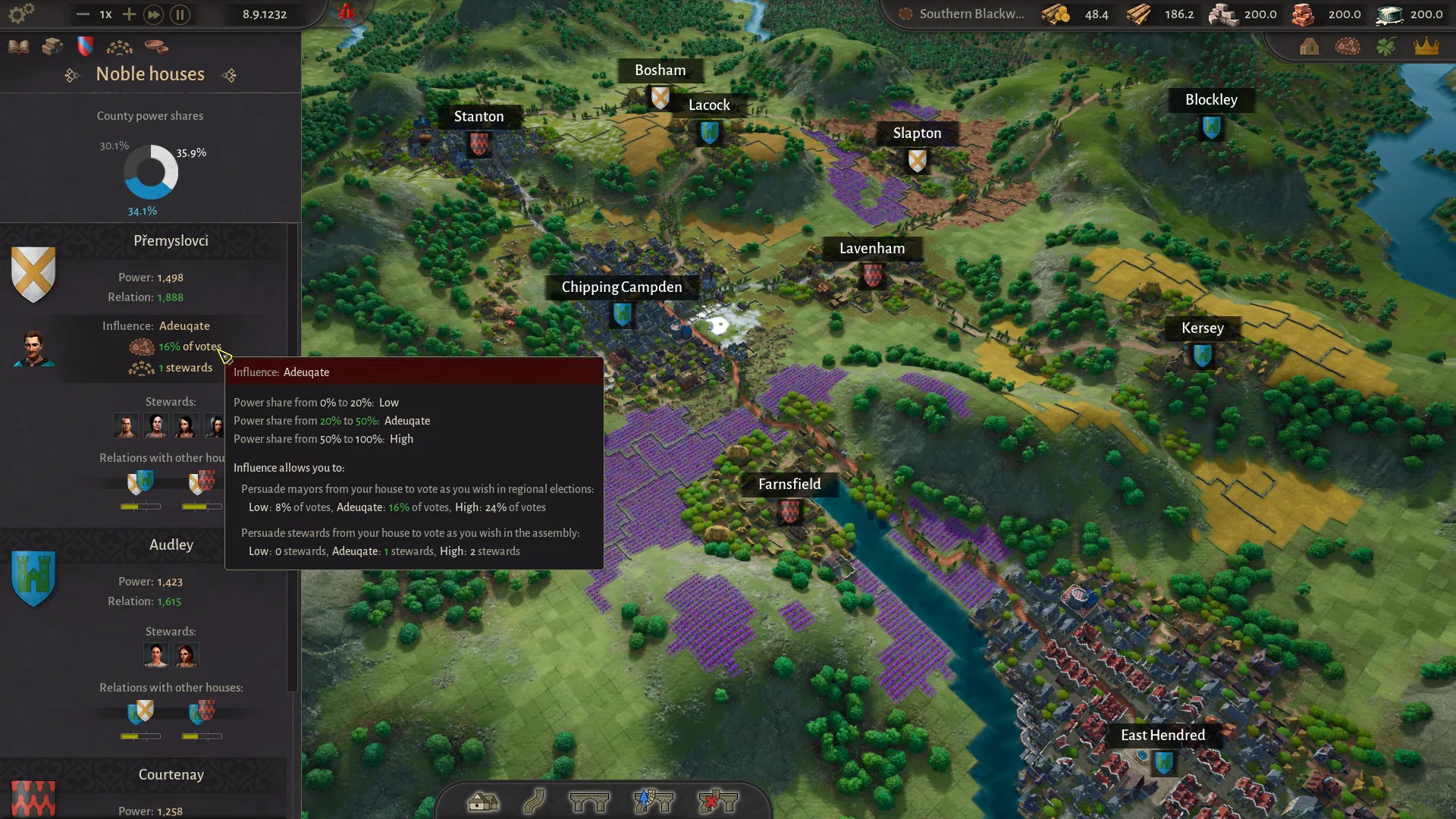
The noble houses panel shows each house’s power, relation score and influence tier. Power share is the key number:
| Power share | Influence | Mayor votes persuaded | Stewards persuaded |
|---|---|---|---|
| 0–20% | Low | 8% | 0 |
| 20–50% | Adequate | 16% | 1 |
| 50–100% | High | 24% | 2 |
The county power shares are shown as a pie chart at the top of the panel. A house with 35% of power is in the Adequate tier; a house with 55% is High. The exact thresholds may shift in Early Access, but the principle is stable: concentrated power buys votes.
Influence is calculated from a house’s share of county power, not its absolute score. A house can grow stronger and still lose influence if its rivals grow faster. Watch the pie chart, not just the raw power number.
Steward elections
Each region has a steward, and the panel shows the next election date, current support and long-term support for the candidates. Houses back candidates; their influence and relations shape the outcome.
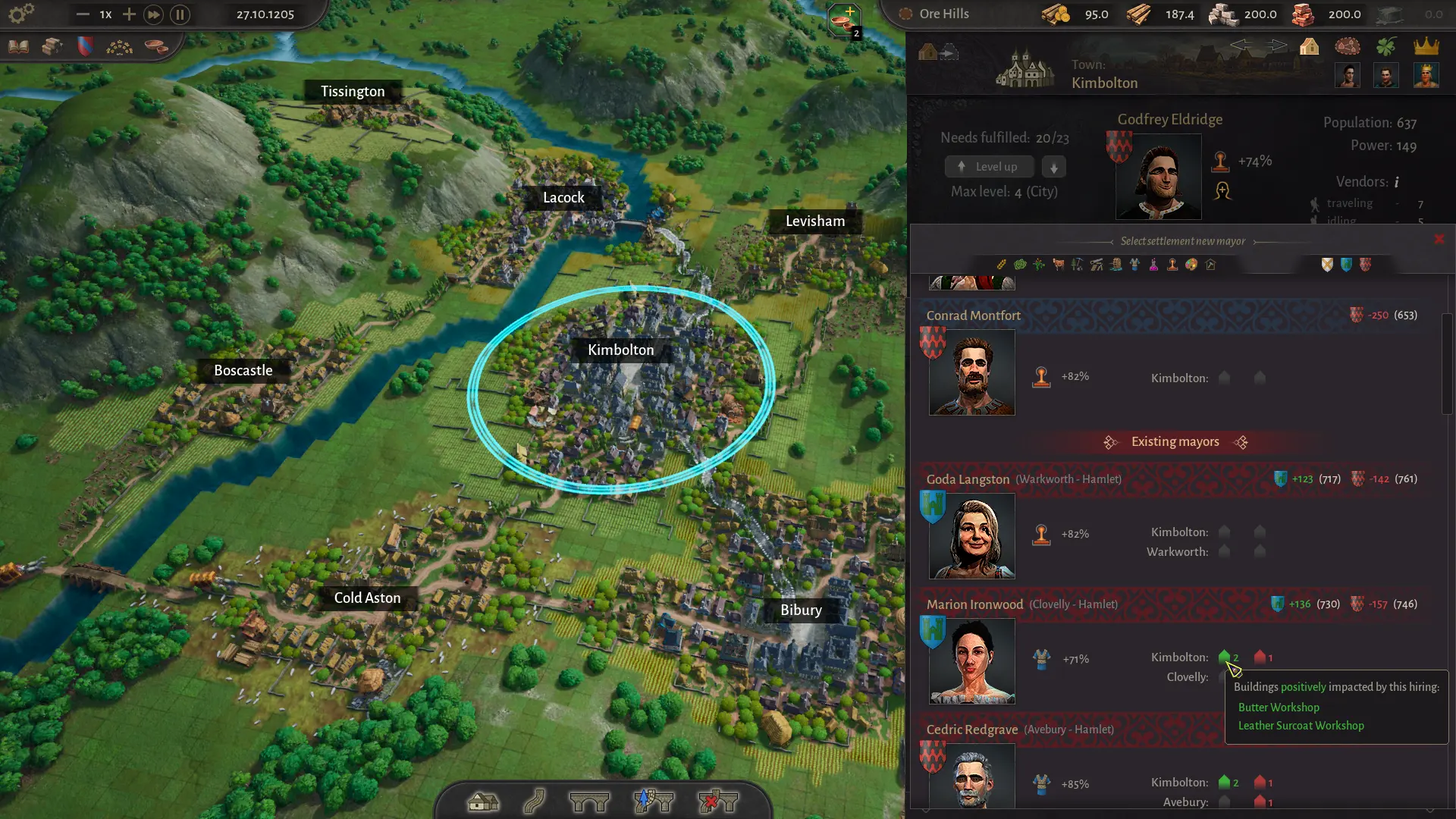
The steward matters because the Assembly is built around regional votes. A steward who aligns with your plans can make privileges easier to pass; a hostile steward can block or redirect them. Appointing mayors from a house increases that house’s presence, which can improve its election prospects over time.
The election UI shows percentages, not a simple “vote for X” button. Treat it as a forecast: current support can change before the election, and long-term support reflects deeper structural advantages.
House relations
Houses track relations with each other. The demo shows relation bars between houses, and the noble houses panel lists each house’s relation score alongside its power. Relations are not fully explained in the demo tooltips, but they clearly feed into the political system.
A practical interpretation: do not treat houses as isolated modifiers. A house that dislikes another may oppose its proposals or refuse to cooperate. If you are trying to pass a privilege, check which houses back it and whether their relations make an alliance plausible.
Political strategy
- Know the power shares. Open the noble houses panel after every regional expansion. A new settlement can shift the balance more than a battle.
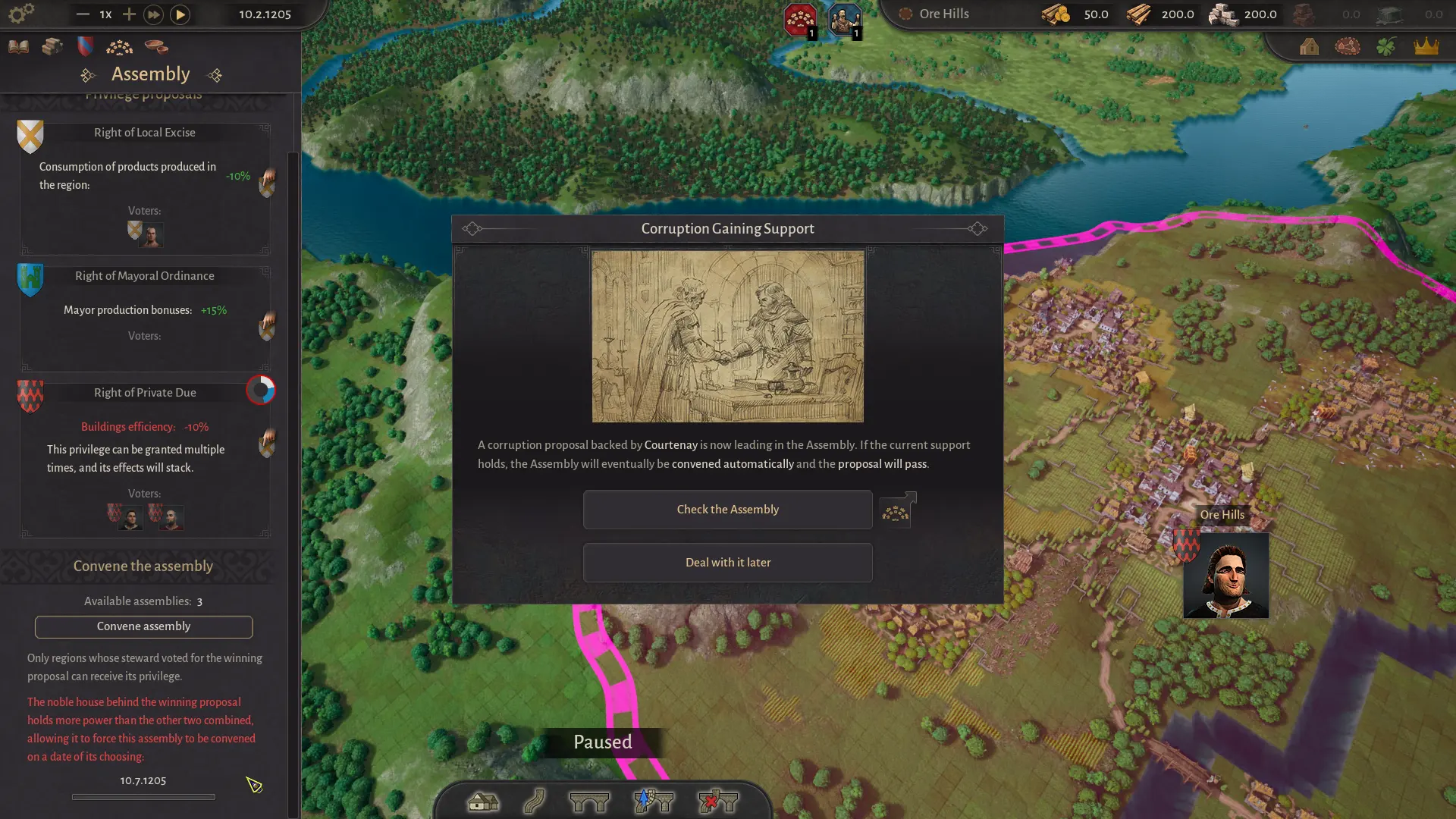
- Do not let one house run away with the county. A house with more power than the other two combined can force an Assembly. Balance appointments if a single house is approaching that threshold.
- Use mayors as political appointments. The best economic mayor may not be the best political one. In the mid-game, consider the house behind the bonus.
- Watch elections early. A steward election can change the region’s political direction for years. Check the next election date before you commit to a long project.
- Attend the Assembly. Influence without participation is wasted. Vote for privileges that support your next economic goal.
Houses and the Assembly
The Assembly is where houses convert influence into regional privileges. Each house proposes a privilege, stewards vote and the winning proposal is granted to a region whose steward voted for it. Only regions whose steward voted for the winning proposal can receive the privilege.
If one house holds more power than the other two combined, it can force the Assembly to convene on a date of its choosing. That is the political equivalent of a monopoly, and it is worth preventing even if the dominant house is currently friendly.
For the full vote and privilege system, see the Assembly guide. For the economic side of mayor appointments, read the mayors guide.
Quick answers
County of Fortune noble house questions
How does noble-house influence work?
A house’s power share determines its influence tier. The demo tooltip defines Low as 0–20%, Adequate as 20–50% and High as 50–100%. Higher influence lets a house persuade more mayors and stewards to vote its way.
How many votes does influence give?
In the demo tooltip, Low influence persuades 8% of mayors’ votes, Adequate 16% and High 24%. For stewards, Low persuades 0, Adequate 1 and High 2. These values may change during Early Access.
Can one house dominate the county?
Yes. If one house holds more power than the other two combined, it can force an Assembly on a date of its choosing. That is a strong reason to monitor power shares rather than only production.
How do mayors affect noble houses?
Every mayor belongs to a house. Appointing a mayor increases that house’s presence and influence in the region, so a strong economic appointment can also shift the political balance.
What are the noble houses in County of Fortune?
The demo shows houses such as the Přemyslovci, Audley and Courtenay, with their own banners and power shares. The full roster and names may vary by map or change during Early Access.