On this page +
Cultures reference
Cultures are County of Fortune’s economic identity system. They decide which goods a region is known for, how strong those production bonuses become and who dominates a settlement’s customs. A culture is not a cosmetic label; it is a long-term investment in a region’s specialisation.
What cultures do
Settlers arrive from different lands, bringing customs that grant bonuses and create tensions. Each culture has a homeland, a population share in every region and a set of Traditional Products. The culture with the largest share in a settlement becomes the dominant culture there.
Cultures gain renown over time. Renown unlocks traits and additional Traditional Product slots, which lets you concentrate bonuses on the goods your region actually produces. The system was reworked in 2026 to make these choices more active.
Population share and dominance
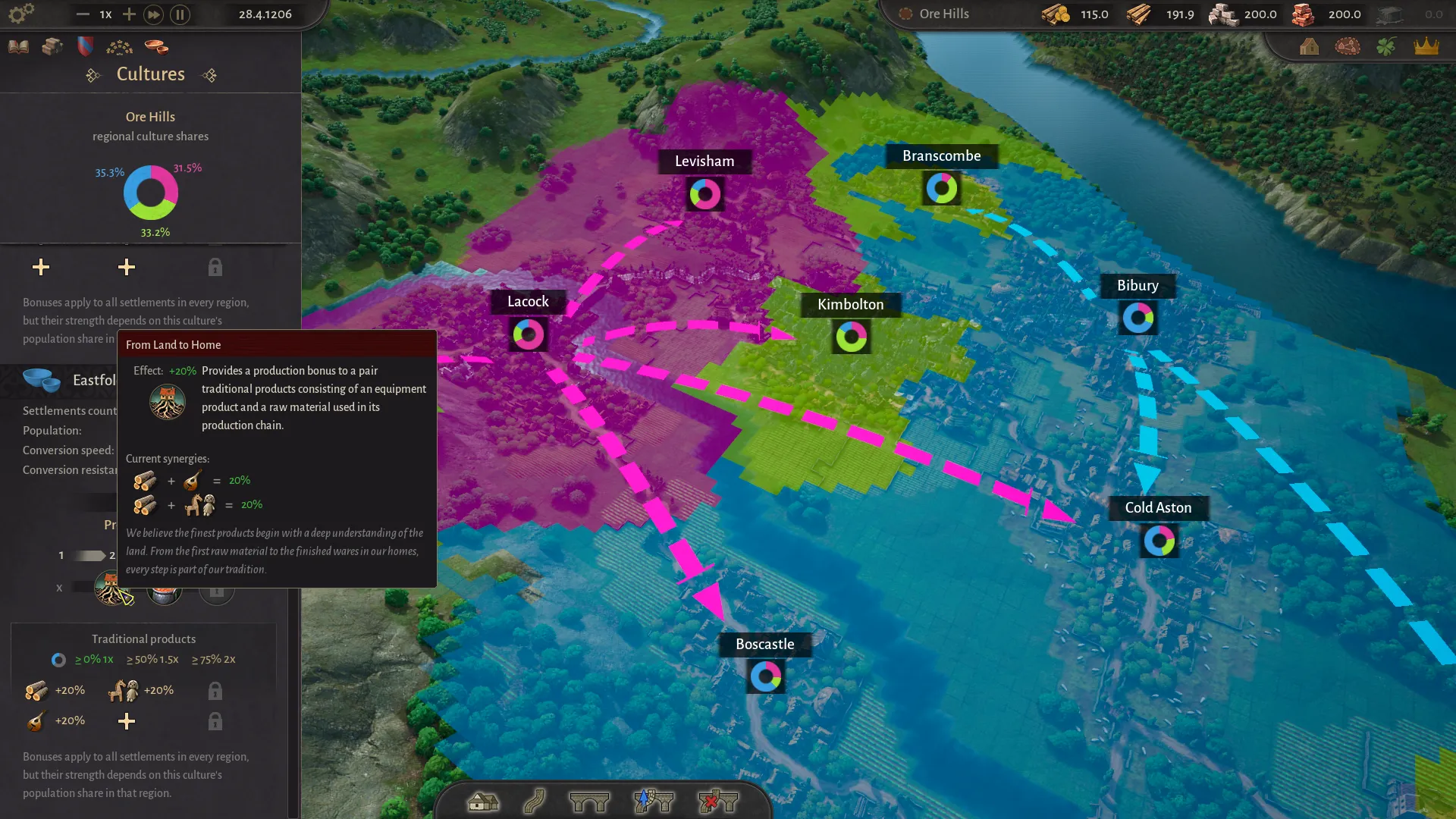
Population share is the multiplier behind every culture bonus. The more of a region’s population belongs to a culture, the stronger its Traditional Product bonuses become there. The demo UI shows three thresholds:
| Population share | Bonus multiplier | Practical meaning |
|---|---|---|
| Below 50% | 1× | The culture is present but not dominant; bonuses are modest. |
| 50% or more | 1.5× | The culture is a major force; specialisation starts to pay off. |
| 75% or more | 2× | The culture dominates the region; its traditional industries receive the full bonus. |
This is why culture is a regional strategy, not a settlement-level toggle. Spreading a culture thin across many regions produces weak bonuses; concentrating it in one region produces a strong specialisation.
Renown and traits
Each culture can increase its renown and gain up to three traits. Renown also unlocks additional Traditional Product slots and, according to the developers, additional products. The exact renown thresholds are not fully documented, but the pattern is:
- Renown 1: six Traditional Product slots.
- Renown 2 and above: two additional slots per new renown level.
- Traits: up to three, unlocked as the culture grows.
Traits are where the system becomes interesting. Instead of a flat bonus to one product, traits create synergies between pairs of Traditional Products. A trait might reward two products that are ingredients in the same recipe, or connect the beginning and end of a production chain.
Traditional Products
Traditional Products are the goods a culture is known for. The rules are:
- You choose which products fill the culture’s slots.
- The culture must have been the largest producer of that product in the region during the last 12 months.
- The base production bonus is intentionally small; the real strength comes from synergy traits and population share.
- Products can be changed later, so a mistake is not permanent.
In practice, choose products your region already makes in volume. A culture that picks a product it barely produces gets a small bonus on a small output. A culture that picks its dominant industry gets a multiplier on the thing that matters most.
Choose Traditional Products that are central to your region’s supply chain, especially goods that feed other industries. A bonus to a finished luxury is nice; a bonus to the input that every workshop needs can be worth more.
Trait synergies
The demo shows traits such as “From Land to Home”, which provides a +20% production bonus to a pair of Traditional Products consisting of an equipment product and a raw material used in its production chain. The tooltip shows current synergy pairs and their bonuses.
This means the best Traditional Product selection is not simply “the six highest-value goods”. It is a set that creates valid pairs:
- Ingredient pairs: two goods used in the same recipe.
- Chain pairs: a raw material and the finished good at the other end of its chain.
- Equipment pairs: an equipment good and a raw material used to make it.
Check the trait tooltip before locking in a set. A pair that looks good on paper may not match the region’s actual production.
Culture strategy
- Decide the region’s identity first. Is it a grain region, a clay region, a wool region or a trade hub?
- Build the production before choosing the culture. Traditional Products require the culture to be the largest producer, so production comes first.
- Concentrate the culture. A 75% share doubles the bonus. Spreading the culture across three regions keeps every bonus weak.
- Choose products that pair. Look for traits that connect ingredients or chain ends, not just high-value finished goods.
- Revisit after expansion. When a new region changes the population balance, the old product choices may no longer be optimal.
Conversion and tension
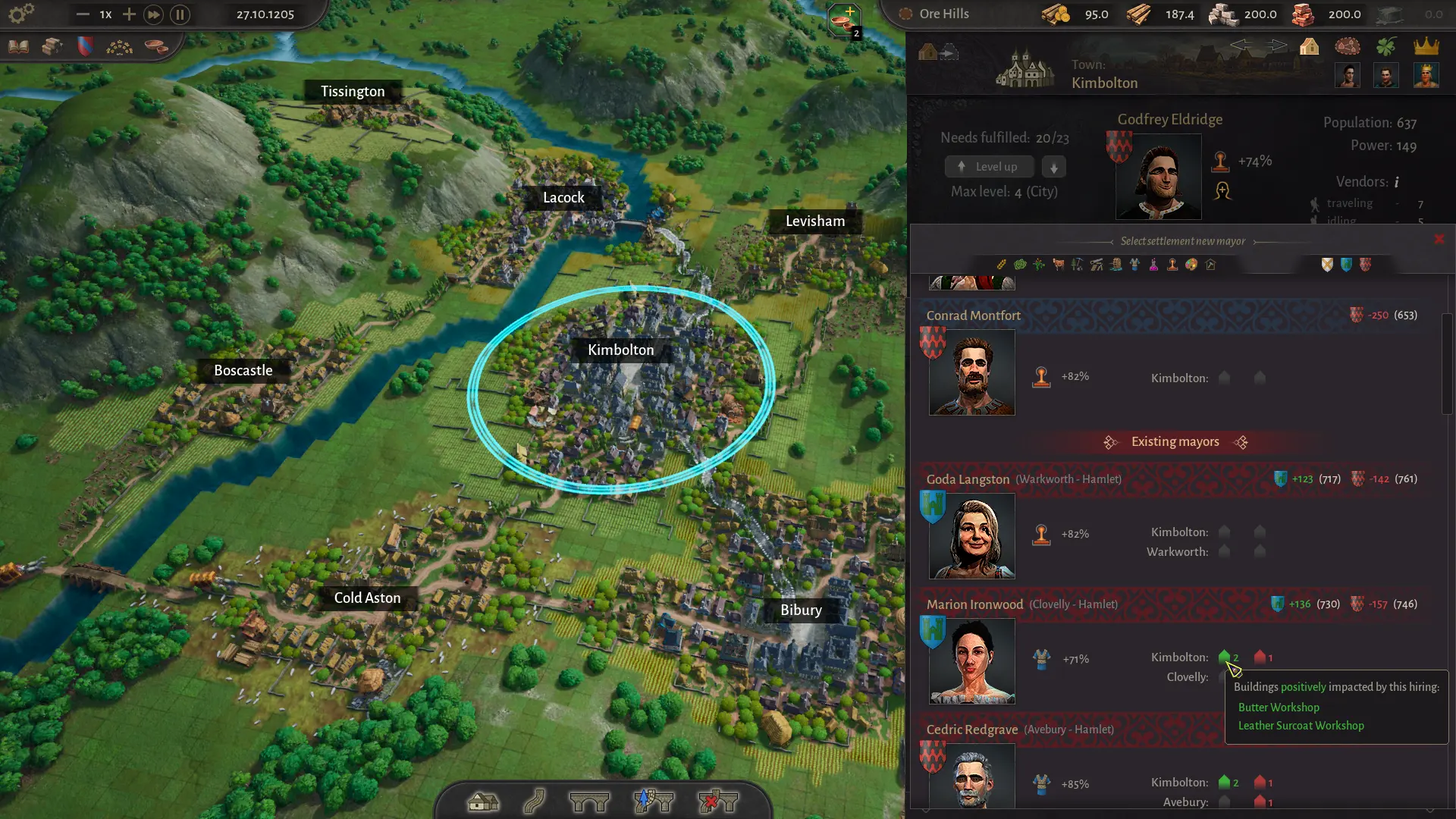
Culture shares change as settlers arrive and as buildings like taverns increase the efficiency of visiting workers and gradually convert them to the settlement’s dominant culture. Conversion is a tool, not automatically a good thing: it can strengthen your preferred culture’s bonus, but it can also create tensions with other groups.
The demo surfaces culture shares and conversion effects, but the full tension system may expand during Early Access. Watch the culture panel after building a tavern, and do not convert a settlement unless the new dominant culture supports your production plan.
A culture change alters population share, bonuses and potentially political relations. If a settlement is producing well under its current culture, leave it alone unless you have a clear economic reason to change it.
For the political side of culture, read the noble houses guide. For the production chains that Traditional Products feed, see the production guide.
Quick answers
County of Fortune culture questions
How many Traditional Products can a culture have?
Each culture starts with six Traditional Product slots. From Renown level 2 onward, every new Renown level unlocks two additional slots. You can change the selected products later, so the choice is not permanent.
How do Traditional Product bonuses scale?
The bonus depends on the culture’s population share in the region. The demo UI shows 1× below 50%, 1.5× at 50% or more, and 2× at 75% or more. Concentrating a culture in a region therefore makes its bonuses significantly stronger.
Can a culture choose any product as traditional?
No. The culture must have been the largest producer of that product in the region during the last 12 months. This keeps Traditional Products tied to what the culture actually makes, while still giving you room to shape specialisation.
What is the dominant culture?
The culture with the largest population share in a settlement becomes the dominant culture there. Dominance matters for culture conversion, tavern effects and the identity of the settlement.
What cultures are in the game?
The demo shows cultures such as the Eastfolk and the Gray Fennas, and the developers have described cultures arriving from different homelands. The full roster may expand during Early Access.