On this page +
Production & economy
County of Fortune’s economy is a chain of transformations. Land produces raw goods, workshops refine them, settlements consume them and trade moves the surplus. Once you see the county as a set of chains, most “why is my town stuck?” problems become traceable.
Think in chains, not buildings
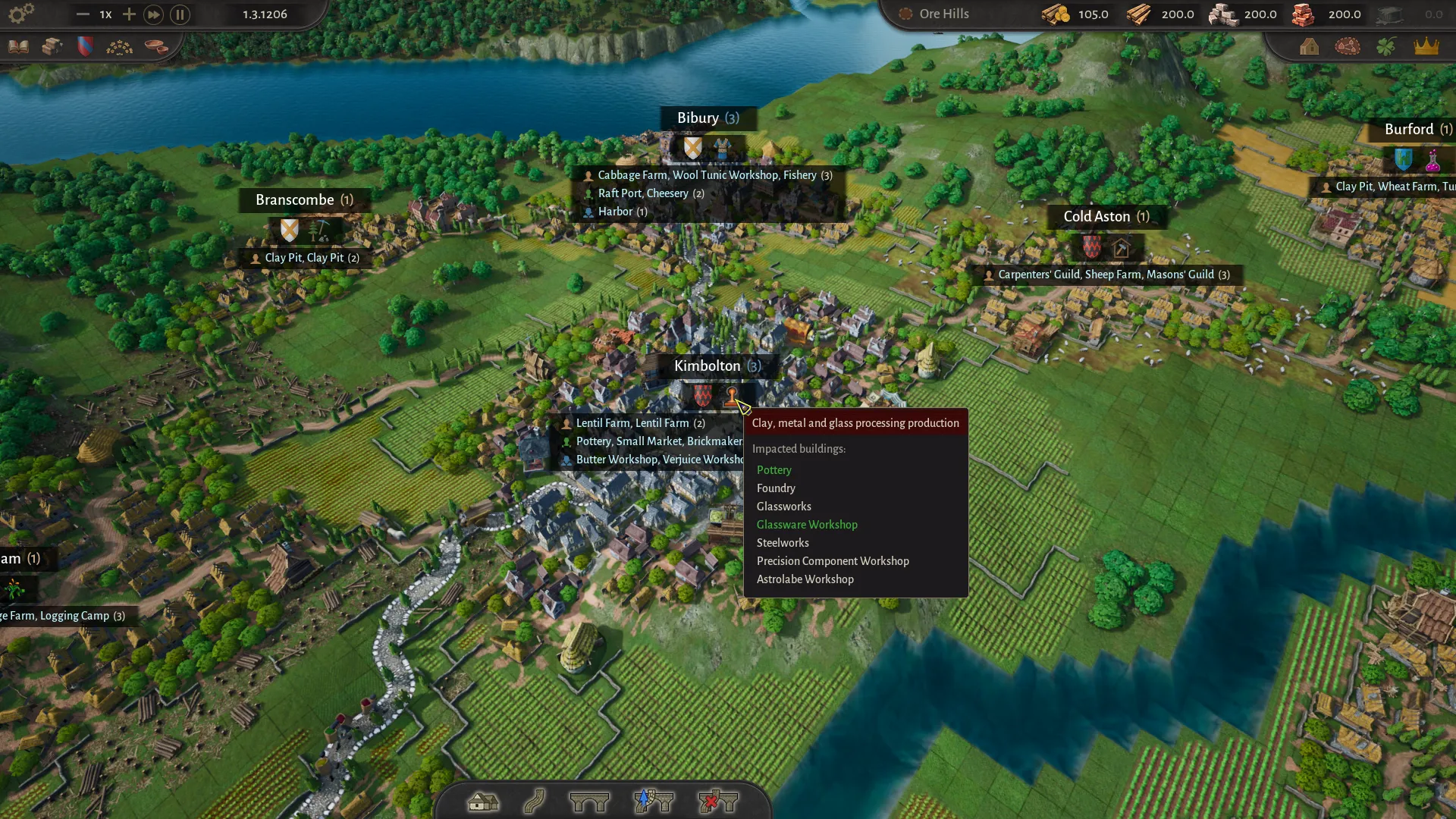
A building is only useful if its input exists and its output has somewhere to go. The game makes this visible through production-chain tooltips, warning icons and arrows added during the 2026 demo updates. Use them.
Every chain has four questions:
- Where does the raw good come from? A farm, quarry, logging camp or pasture.
- What transforms it? A workshop, mill, bakery, guild or refinery.
- Who consumes it? A settlement need, another building’s recipe or a trade route.
- How does it get there? Roads, markets, raft ports or ports.
If any answer is missing, the chain is broken. Building more of the final producer will not fix it; you need the missing link.
The four good categories
| Category | Examples | Purpose |
|---|---|---|
| Food | Cabbage, turnips, beans, grain, beef, cheese, bread | Keeps settlements alive; variety supports growth and higher classes |
| Equipment | Wooden chests, wool tunics, leather surcoats | Unlocks building slots and raises worker capacity |
| Construction | Logs, stone, clay, planks, bricks, carpentry and masonry points | Builds and maintains roads, guilds and production buildings |
| Luxury & high-tier | Candles, ceramic tableware, musical instruments, medicine, painted cabinets | Satisfies Artisans and Patricians; supports high population and prestige |
Example production chains
These are examples observed in the demo build. Early Access adds more than 50 products, so treat them as patterns rather than a complete recipe book.
Bread chain
Wool clothing chain
Timber and construction
Logs also feed the Wooden Chest Workshop, one of the earliest equipment chains.
The Artisan food example
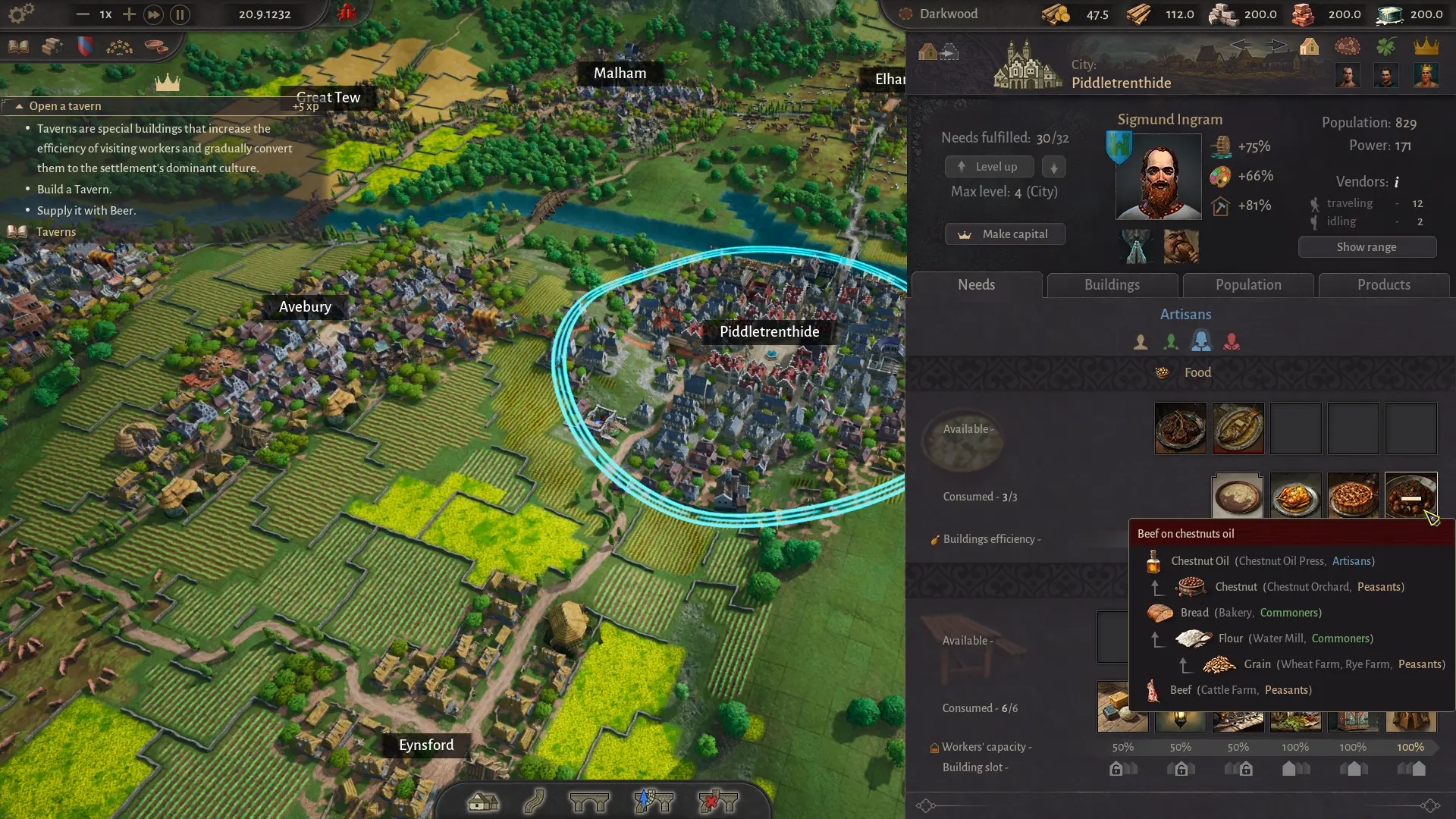
The demo’s Artisan food tooltip shows a composite dish called “Beef on chestnut oil”. Its chain illustrates how higher classes demand multiple interlocking products:
- Chestnuts from a Chestnut Orchard, pressed into chestnut oil at a Chestnut Oil Press.
- Grain from a wheat or rye farm, milled into flour, baked into bread.
- Beef from a cattle farm.
- All of it supplied to the settlement so Artisans can consume the dish.
This is why one “food settlement” is not enough at higher levels. A city needs several raw chains, several processing buildings and a transport network that keeps them all fed. Plan the chain before you level the settlement.
When you add a workshop, add its input producer in the same planning session. A bakery without a mill is a queue of idle workers; a mill without grain is the same problem one step earlier.
Workers and efficiency
Production buildings have a maximum output, but they only reach it when they have inputs, workers and maintenance. The building card shows efficiency, workers and productivity. A building at 60% efficiency is not broken; it is under-supplied.
- Workers: level two increases the maximum worker count when you supply more equipment.
- Recipes: adding a valid recipe can raise a building’s efficiency if the settlement has the inputs.
- Mayor bonuses: a matching mayor can add a large percentage to specific building types.
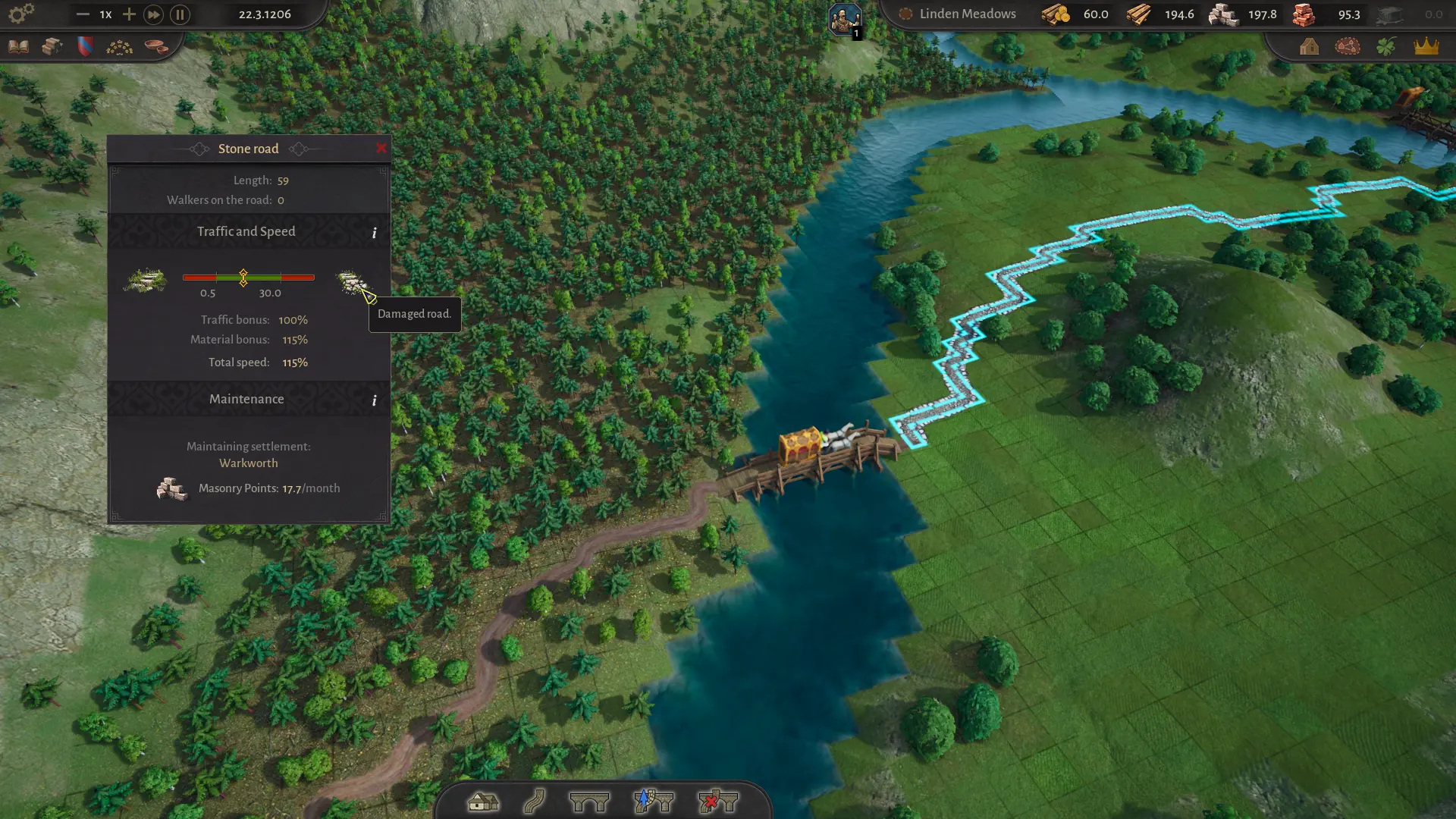
- Maintenance: guilds keep buildings and roads in repair. Neglect shows up as a damaged road or reduced output.
- Inputs: the warning icon means a recipe is missing something. Do not ignore it.
Food and class progression
Peasants are satisfied by simple food. Commoners want more variety and processed goods. Artisans expect composite dishes. Patricians want luxuries that require long chains and a stable regional economy.
The practical rule: stabilise one food before adding a second, and stabilise two before adding a third. Each new need consumes storage, workers and transport. A region with five intermittent foods is less stable than one with two reliable ones.
The social classes guide explains which needs unlock at each level. The resources reference lists the goods seen in the demo.
Construction points are part of production
Carpentry and masonry points are produced by guilds and consumed by building and road maintenance. They are not a separate abstraction; they are a chain:
- Logs → Carpenter’s Guild → Carpentry Points
- Stone → Mason’s Guild → Masonry Points
If construction stalls, the answer is usually to expand the guild, supply more logs or stone, or reduce the number of simultaneous projects. Free construction points can cover gaps early, but they are limited. Read the construction points guide for the full system.
Regional specialisation
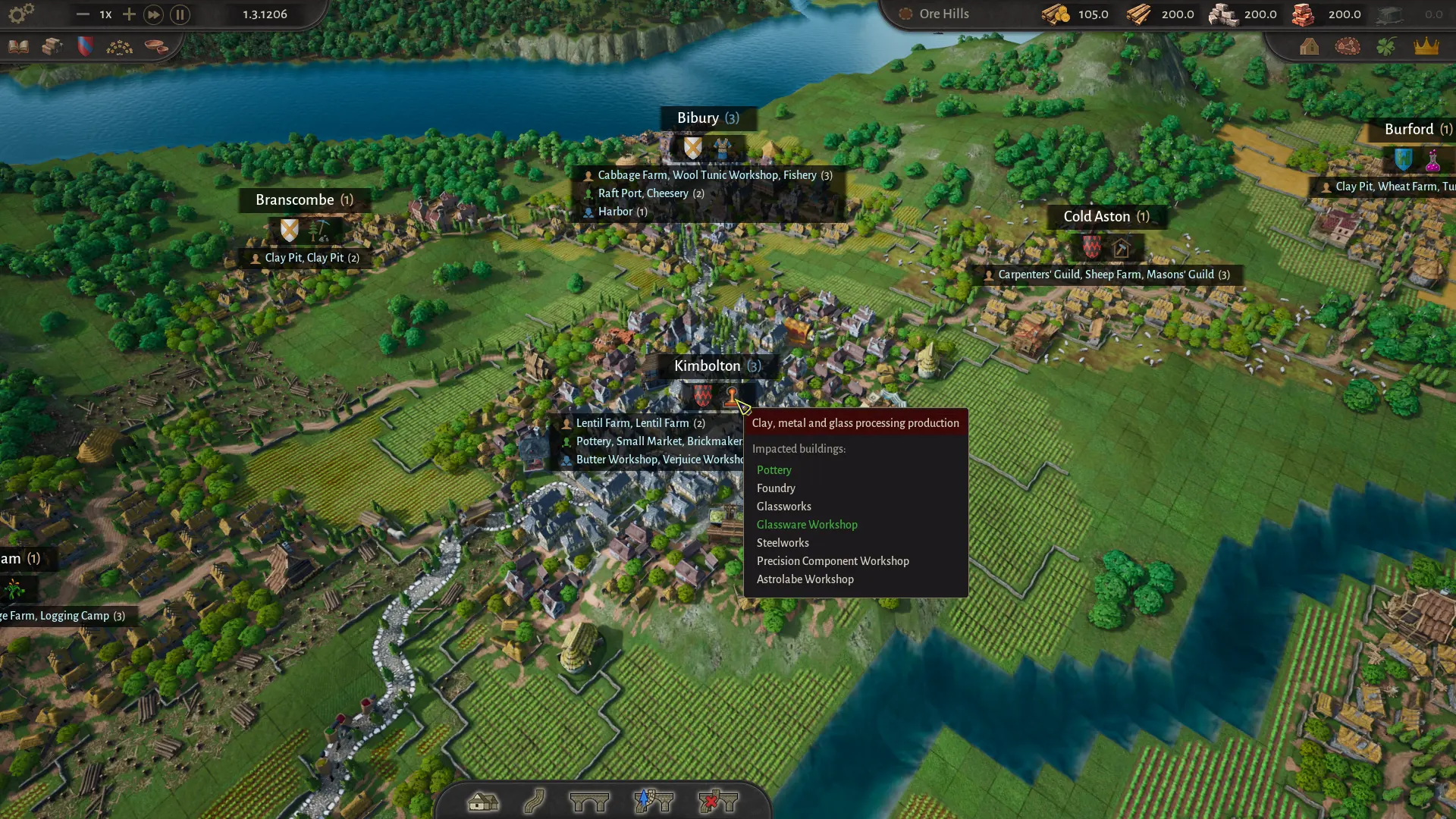
County of Fortune rewards settlements that lean into their terrain. A region with good clay should export pottery and bricks, not try to grow wheat on poor soil. A forest region should supply logs, carpentry points and wooden goods. A river settlement should become the market or port that connects them.
Specialisation creates dependencies, and dependencies require trade. That is the intended loop: you are not trying to make every settlement self-sufficient, but to make the region self-sufficient and the county greater than its parts.
Diagnosing bottlenecks
| Symptom | Check first | Then |
|---|---|---|
| Workshop idle | Missing input warning | Find the input producer; check storage and road access |
| Low efficiency | Worker count | Supply equipment, add recipes, appoint a matching mayor |
| Goods pile up | Storage cap | Add a market, trade route or consumer |
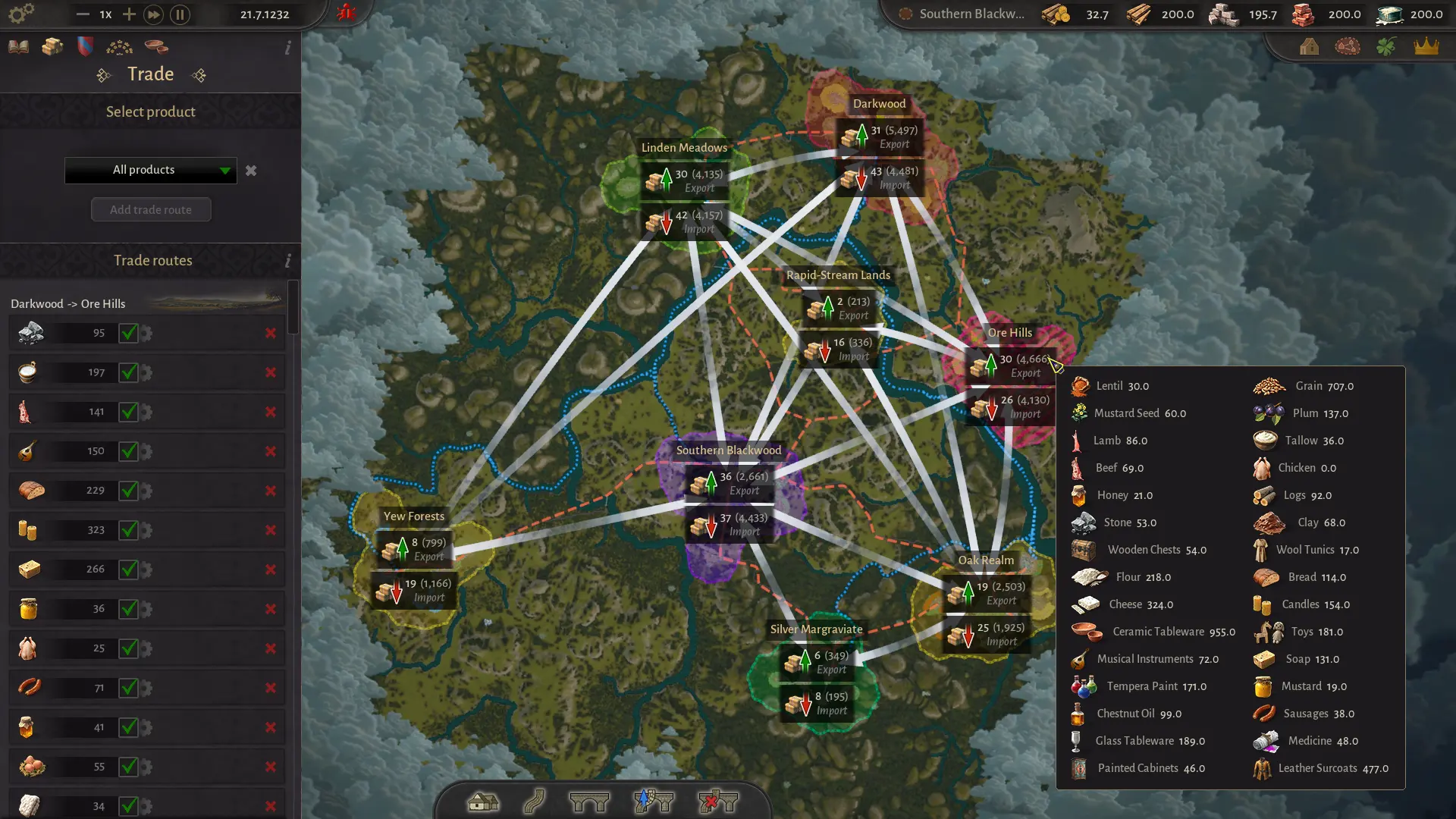
| Goods vanish from a settlement | Another settlement is importing them | Check trade routes and auto-trade volumes |
| Construction stalled | Carpentry/masonry points | Expand guild, supply logs/stone, reduce concurrent builds |
| Food shortage after level-up | New class needs | Add the required food before leveling another settlement |
If the chain is sound but goods still will not move, the problem is probably transport. Continue with the trade routes guide or keep the buildings reference open while you plan.
Quick answers
County of Fortune production questions
What is the most important production chain in County of Fortune?
Food is the first priority, followed by equipment. Food keeps settlements alive and supports leveling; equipment unlocks building slots and raises worker capacity. Construction goods matter next because they gate building.
Why is my production building not producing?
The three usual causes are a missing input, too few workers, or no route to the input. Hover the building’s production chain, check the warning icon and confirm the input is produced, stored and connected.
Do I need every food type?
No. A settlement benefits from variety, but a reliable supply of two foods is better than an intermittent supply of five. Add a new food only when the existing chains are stable.
How do I increase building efficiency?
Supply the required inputs, provide enough workers, add recipes that use the settlement’s strengths, and appoint a mayor whose bonus matches the building. Equipment also raises the worker cap at level two and above.
What are carpentry and masonry points?
They are construction currencies produced and maintained by guilds. Carpentry points come from a carpenter’s guild and wood; masonry points come from a mason’s guild and stone. They pay for buildings and road maintenance.